
How to Check for a Warrant in Lafayette County
The first stop is the Arkansas Judiciary's Search ARCourts service. It is a case-information tool, not a warrant register. What you get is context: a criminal case, a docket event, a charge, a future setting, a judgment, or a public document that points you toward the right court to call. Type the full legal name, and add a case or citation number if you have one. A name match alone proves nothing about identity or warrant status. Lafayette County also posts no public warrant list and no searchable sheriff warrant database, so plan on a short chain of checks instead. Gather the name, date of birth, likely court, and any case or citation number before you pick up the phone. Share personal details only through official court or agency channels.
- Search the Arkansas court portal for the name or known case.
- Identify whether the file belongs to Circuit Court or a district department.
- Call the Lewisville, Bradley, or Stamps district clerk for a local misdemeanor, traffic, ordinance, or missed-date matter.
- Call the Circuit Clerk for a circuit criminal or felony file, or the Sheriff's Office when service must be confirmed.
- Ask an Arkansas lawyer about a recall, reset, bond, or planned appearance before acting on an active warrant.
Lafayette Warrant Search Channels
Each public channel answers a different piece of the question. Search ARCourts gives the broad view of public case information. The Lafayette County Circuit Clerk keeps the circuit criminal files. Each Thirty-Seventh District Court department has its own clerk for local matters. The Lafayette County Sheriff's Office can speak to its own service or custody role, and its public app adds contacts, forms, an inmate search, press releases, a tip form, and a curated Most Wanted feed. None of those features amounts to a complete active-warrant search.
| Channel | Best use | Key limit |
|---|---|---|
| Search ARCourts | Find a public case and its court | Not a complete warrant register |
| District clerk | Confirm local traffic, misdemeanor, ordinance, or FTA events | Department-specific records |
| Circuit Clerk | Confirm circuit criminal and felony case events | Does not keep district files |
| Sheriff's Office | Ask about service, custody, or the agency record | Public app has no full warrant lookup |
Types of Warrants in Lafayette County
The label on the docket matters. An arrest warrant authorizes an arrest. A bench or failure-to-appear warrant usually follows a missed setting or an unmet court condition. Search warrants target a place or property, and they are no substitute for a personal warrant check. Traffic and ordinance warrants can grow out of a missed district-court date. Lafayette County's court plan adds a wrinkle: an AW arrest-warrant docket and an SW search-warrant docket can exist before any criminal case file opens.
| Warrant Type | How It Arises | Who Issues It |
|---|---|---|
| Arrest warrant | Sworn facts or judicial knowledge provide reasonable grounds | Judge or magistrate |
| Bench or FTA warrant | A person misses court or does not obey a court condition | Judge in the assigned department |
| Search warrant | Probable cause supports a search of named property or a place | Judge or magistrate |
| Traffic or ordinance warrant | A required local court date or obligation is missed | Thirty-Seventh District Court department |
Lafayette AW and SW Dockets
The Thirty-Seventh District Court administrative plan gives Lafayette County a useful local clue. A warrant may sit on a warrant docket before the related criminal case file even opens. The plan splits AW arrest-warrant dockets from SW search-warrant dockets. Once a criminal case opens, that warrant-docket material moves into the case file. That is why you may find a docket number or event instead of a tidy warrant card. Remember that a prefix is not a status. An AW reference does not prove the warrant is still active, and an SW reference concerns a search, not authority to arrest a named person. Ask the right clerk what the current docket event means for Lafayette County. A recall, service, quash, or clearance date can change the answer even when an older entry still shows.
What a Lafayette County Warrant Record Shows
A public record can show the case, the issuing court, the alleged offense, and later events. Exact fields vary by court. Bond information is case-specific, and Lafayette County publishes no countywide bond schedule. Status words need care too. Issued, active, served, recalled, cleared, and quashed all mean different things. A recalled warrant can leave the underlying charge and the next court date fully in place.
| Warrant or docket number | May include a local AW or SW docket prefix |
|---|---|
| Case or cause number | Links the process to the underlying court file |
| Charge or offense | States the allegation or statute context, not guilt |
| Issuing court | Names the court or Lafayette district department that controls the record |
| Bond | Shows a case-specific amount or condition when public |
| Status event | May state issued, active, served, recalled, cleared, or quashed |
Search ARCourts in Lafayette County
The Arkansas Judiciary explains Search ARCourts as a public case-information service. The participant search takes first, middle, and last name, plus an organization or case-description field. More court and case-number filters may appear in the live system. Results can give you the court and case context you need before calling the Lafayette County clerk. Public access still operates under Administrative Order 19. The official portal view shows the search form itself, with no person's record displayed.
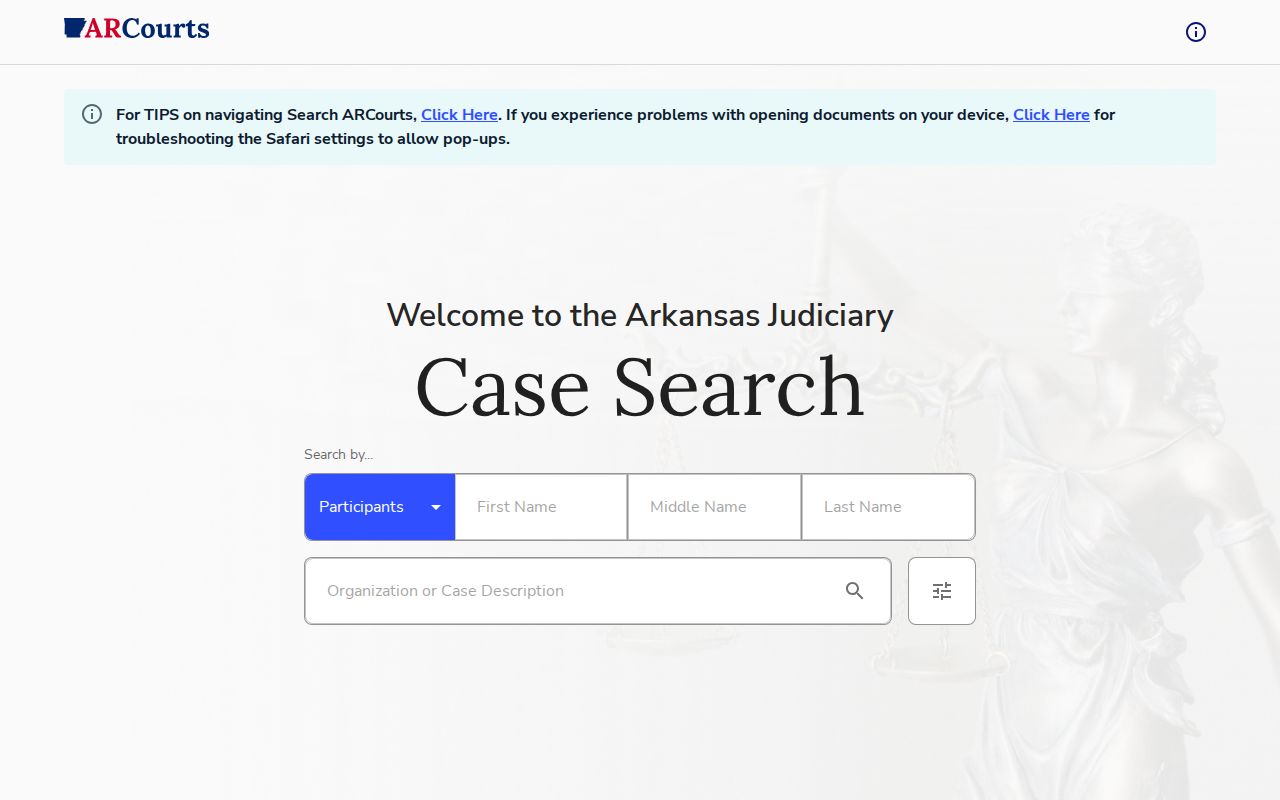
Use the form to find the right Lafayette County case. Then confirm any warrant event with the office that keeps that file.
Who Issues and Serves Lafayette County Warrants
Courts issue Lafayette County warrants. Certified law-enforcement officers then execute the warrants delivered to them. Circuit Court in the Eighth South Judicial Circuit handles felonies and other circuit matters, and Circuit Clerk Dana Phillips keeps those files. The Lafayette departments of the Thirty-Seventh District Court handle misdemeanors, traffic, ordinance cases, preliminary matters, and local warrant dockets; those departments sit in Lewisville, Bradley, and Stamps, after the old city courts were consolidated into them in 2012. The Sheriff's Office may hold a service or custody record, but it cannot answer for the issuing court on a recall or next setting. That split makes the court name on a citation, notice, or search result your best routing fact in Lafayette County.
Lafayette County Sheriff's Office
5 Courthouse Square
Lewisville, AR 71845
(870) 921-4252
Lafayette Clerk Routing Matters
Lafayette County is small, but that does not mean one simple records counter. Two different offices answer to "clerk" here. Dana Phillips holds the Circuit Clerk seat and keeps the county's circuit criminal files. County Clerk Angela Brazell handles administrative records instead. District cases route by department: Ashley Lynd serves as chief clerk in Lewisville, Misty Williams in Bradley, and Brenda Force in Stamps. The Arkansas circuit-clerk directory shows the Lafayette County Circuit Clerk entry used for circuit routing.
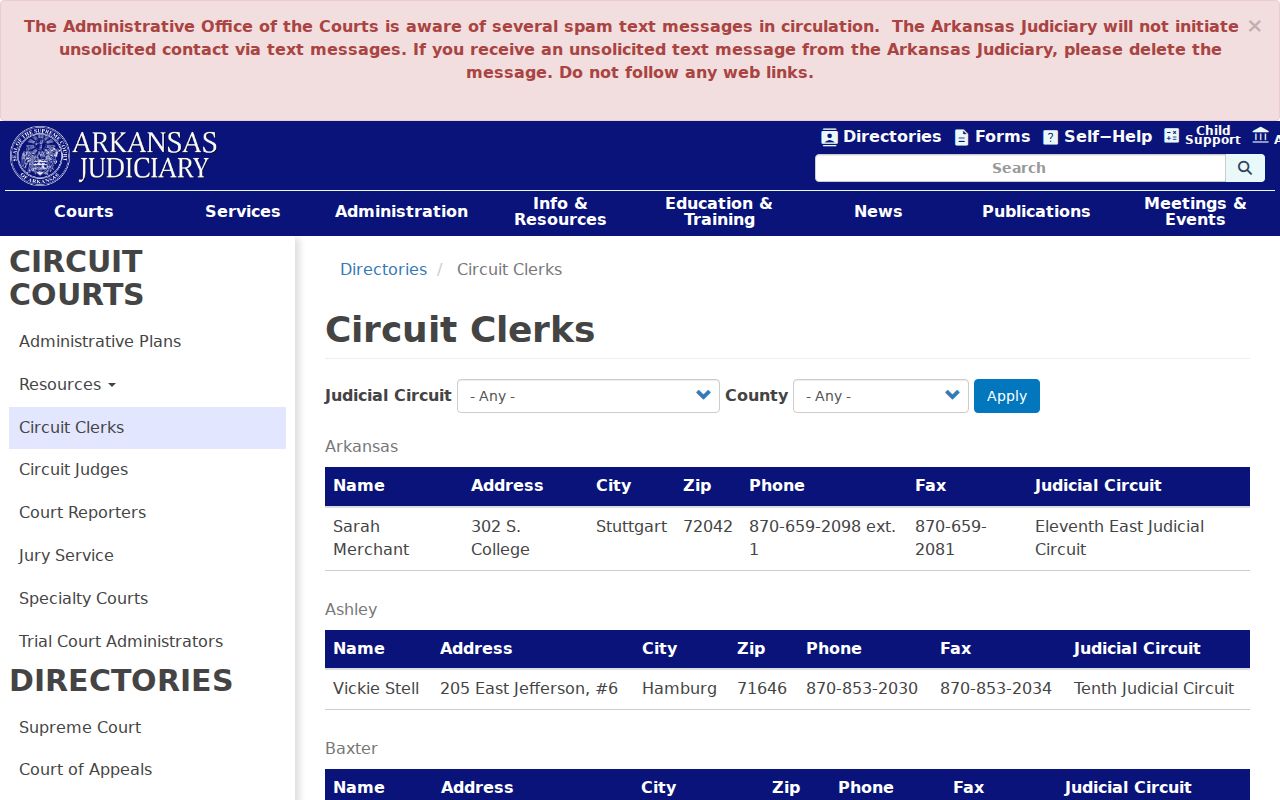
The directory covers circuit files only. A district warrant question in Lafayette County belongs with the department that opened the local case.
What to Do If You Have a Lafayette County Warrant
Start by pinning down which court issued the Lafayette County warrant. A district matter goes to the Lewisville, Bradley, or Stamps clerk. Circuit criminal cases belong to the Circuit Clerk. Ask about the docket status and what the judge allows. Options can include a reset, an attorney appearance, a recall or quash motion, a scheduled surrender, payment, bond, or a first appearance. No public Lafayette County bond schedule applies to every case. Do not assume an online payment clears a warrant. Arkansas's citation portal covers only participating courts and adds a service charge. Its warning is blunt: full payment waives appearance and trial through a guilty or no-contest disposition. Lafayette County courts may not all take part. A clerk should confirm whether payment is allowed and what effect it has. After any court action, get a docket or written update. Then ask whether the recall reached the serving agency.
Important: Ask an Arkansas lawyer and the issuing clerk about the safest lawful appearance before reporting in person on an active warrant.
Lafayette Warrant Payment Scam
The Lafayette County Sheriff's Office has warned about callers and texts that threaten arrest. The demand is for money or gift cards. The warning sets one clear rule. An incoming demand is never proof of a warrant. End the contact, then use a phone number published by the Arkansas Judiciary or the Lafayette County Sheriff's Office. A genuine court record can be checked through the court's own channel, and the official sheriff press-release feed carries the local scam warning.
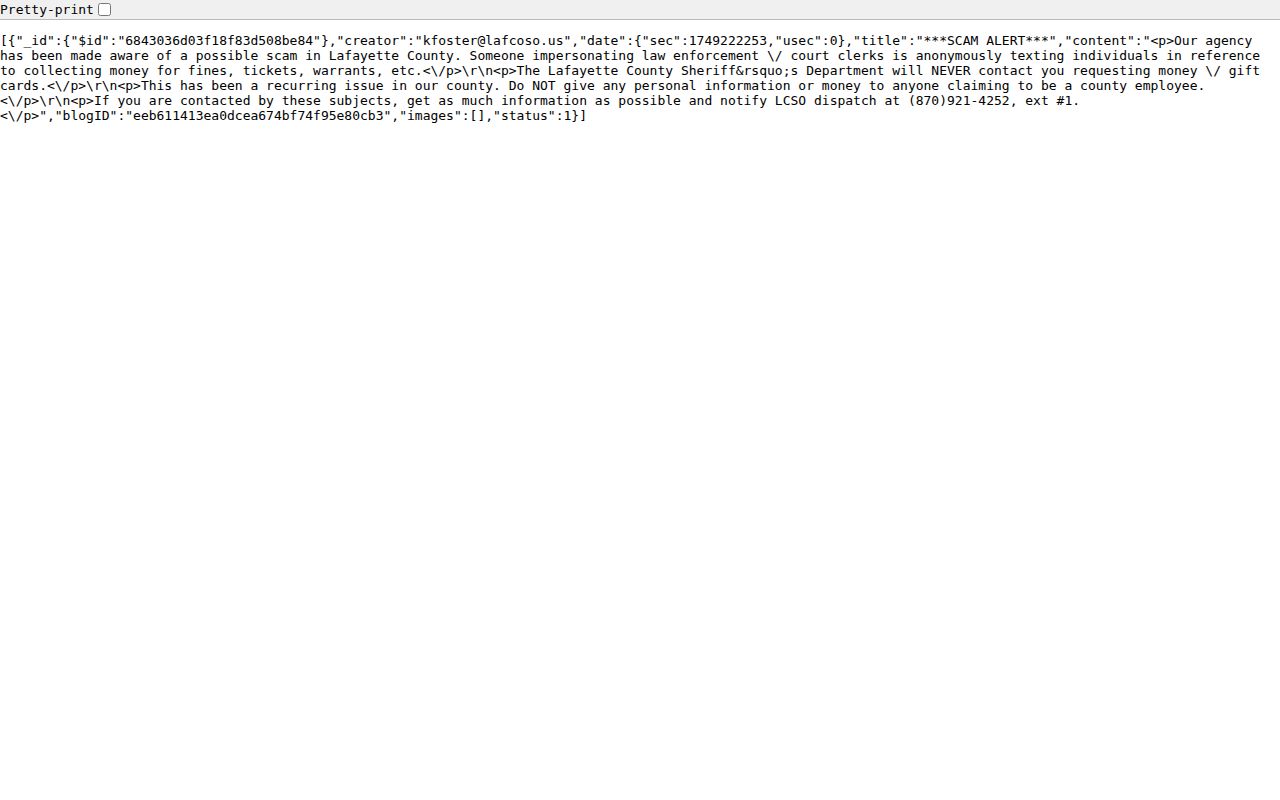
The alert's point is simple. Verify through an official Lafayette County clerk or sheriff number before any money or personal data changes hands.
Lafayette Most Wanted Limits
The sheriff app carries a curated Most Wanted feature. It offers no public name search or sort control, hides display dates, and limits the list view. It is not the full Lafayette County active-warrant register. The inmate search is separate. It reports custody details, not whether an unserved warrant exists. A missing name on either feature proves nothing about a person's warrant status. For your own status, run Search ARCourts and call the issuing clerk. Call the Sheriff's Office to confirm service or custody. Lafayette County readers should view official Most Wanted material only on the agency's own page.
Public Access to Lafayette County Warrant Records
The Arkansas Freedom of Information Act backs public access. It opens agency records during regular business hours, subject to exemptions. A strong request names its target. List the record, the likely custodian, the court or department, a date range, and a case number if known. Lafayette County offices hold different records. A broad request to the wrong clerk can stall. Requests go by whatever methods the statute allows, and Lafayette County publishes no special warrant-request form, email address, fee schedule, or fixed response time.
Key Rules:
A.C.A. §25-19-105 supports inspection and copying of public records while preserving statutory exceptions.
Administrative Order 19 limits some information and documents in public court access.
A.C.A. §9-27-309 protects juvenile records and prevents an adult-facing search from becoming a juvenile lookup.
Lafayette FOIA Request Details
Keep the request focused on one useful item. That could be a warrant docket or status, a recall notice, a service record, or the related case docket. Name the venue. Say whether the case sits in Circuit Court or the Lewisville, Bradley, or Stamps district department. Add an approximate issue or missed-date range plus the case or citation number. If the venue is unknown, say so. Ask the recipient to name the likely custodian. Ask the Lafayette County office to confirm its delivery method, copying fee, identification rule, and any redaction that applies. A Lafayette County custodian may produce the record, cite an exemption, or point you to another office. Sealed, protected, juvenile, safety-sensitive, or active-investigation material may stay closed. Public does not mean everything appears online.
Lafayette Warrant Status Terms
Short labels carry big consequences. Read Lafayette County status terms against the issuing court's docket, never as stand-alone promises.
- Active or outstanding
- The system has not marked the process served, recalled, or otherwise cleared; confirm with the court.
- Failure to appear
- A missed required appearance after a citation, summons, or release condition, often shown as FTA.
- Recall
- The court withdrew the warrant; ask whether notice reached the law-enforcement agency.
- Served or executed
- An officer carried out the warrant, which does not state the final result of the case.
- Cleared or quashed
- The warrant is no longer active through an administrative or judicial event, though the case may continue.
Lafayette Court Geography
Lafayette County is small. Even so, no single records counter handles everything. Court work spreads among three district departments and the circuit office in Lewisville. A resident can live near one city. Yet the case may sit in another department. Taylor also straddles the Lafayette and Columbia County line, so the court named on the citation or case record controls routing. The official county directory helps separate Lafayette County offices from the courts that keep criminal files.
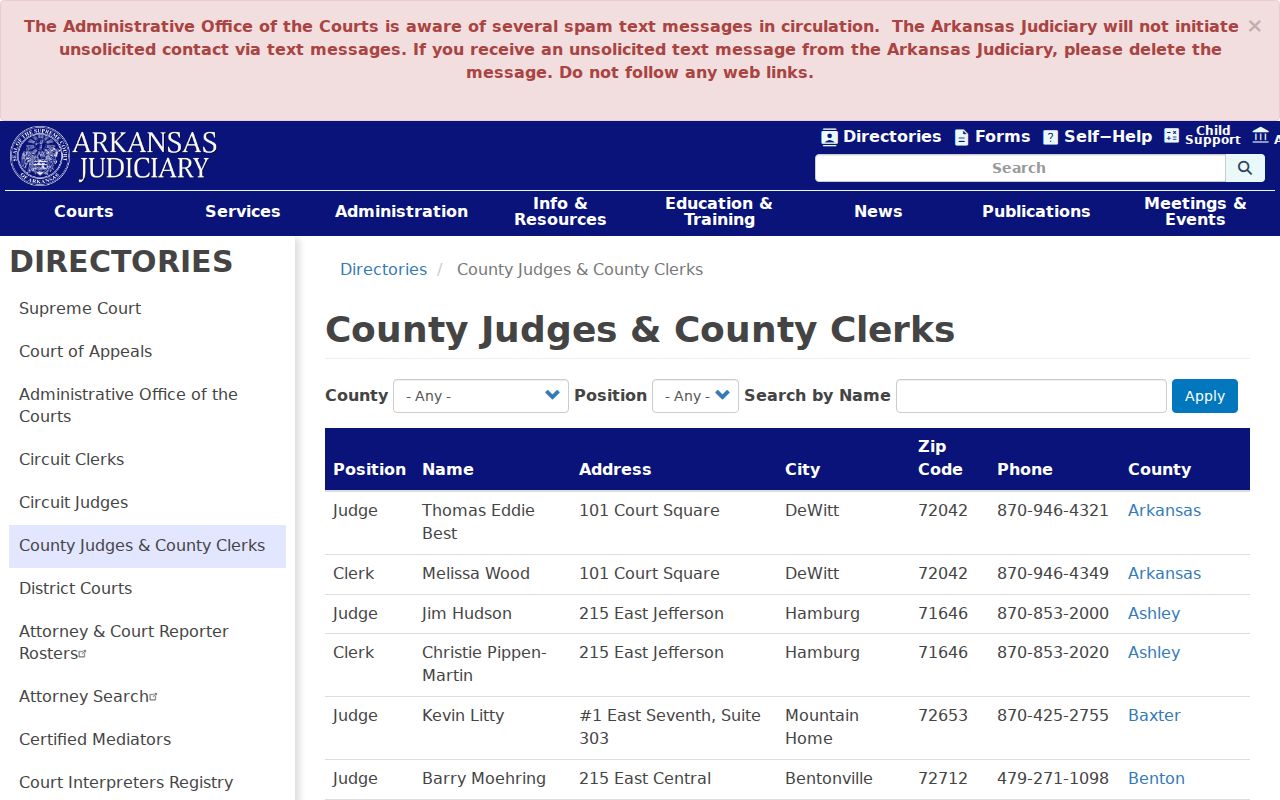
Treat the directory as a routing aid only. For a live warrant status in Lafayette County, the issuing court remains the best source.
Warrant Records by City in Lafayette County
Five Lafayette County communities appear below, ordered by their population in the 2020 Census: Stamps, Lewisville, Taylor, Bradley, and Buckner. Where a city sits tells you nothing about who holds a warrant record. Local courts here folded long ago. The old city benches in Stamps, Bradley, and Lewisville became departments of the Thirty-Seventh District Court, so their contacts now run through those district departments rather than separate municipal courts. Taylor spills across a county line, and Buckner offers no local warrant portal to search. Each city section below opens with what that town actually provides, then sends you to the right court or sheriff channel for a warrant check.
Stamps Warrant Records
1,258 · Stamps has a named district department and an official city contact route.
Lewisville Warrant Records
915 · Lewisville is the county seat and hosts circuit and district court contacts.
Taylor Warrant Records
579 · Taylor spans Lafayette and Columbia Counties, so venue must be checked.
Bradley Warrant Records
405 · Bradley has its own Lafayette district-court department and chief clerk.
Buckner Warrant Records
165 · Buckner checks route through the county court and sheriff channels.